

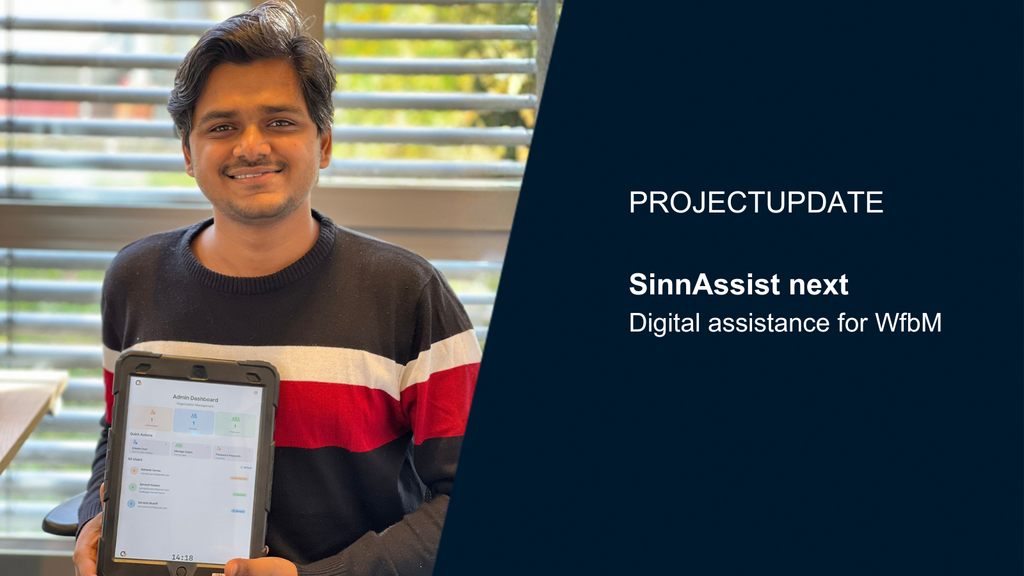
In what ways can digital systems provide practical support to people in their everyday working lives? This question is being addressed by the SinnAssist next project, which has been underway since June 2025 under the leadership of Prof. Dr. mult. Carsten Röcker and his Human-Technology Interaction research group. The project team has now reached several important milestones: the first modules are operational, workflows can be digitally mapped, and development of the web-based planning app is progressing rapidly.
Digital planning as support in everyday workshop life
At the heart of the project is a digital planning assistance system that is being developed specifically for workshops for people with disabilities (WfbM). Designed to help specialists structure the working day clearly and adapt it to individual needs, it provides targeted support. This gives employees who need support greater orientation and independence in their everyday work. The digital daily planner enables tasks, routines and attendance or absences to be managed flexibly, eliminating the need for handwritten lists or manual coordination.
Compared to analogue methods, the digital approach enables continuous development through features such as feedback functions, visualisations and integration into existing workshop processes. The daily planner is therefore much more than a calendar; it is a central tool for structured support and a practical introduction to digital transformation in supported work.
From research to application
The first few months of SinnAssist next were dominated by prototype implementation:
- User and task management are functional,
- recurring workflows can be mapped as routines,
- absences can be documented and automatically taken into account in daily planning.
A particular focus is currently on the web-based planning app that Ratnesh Varma is working on. It is to be expanded to include a cloud service so that the system can also be used across locations within an entire workshop.
Cooperation and goal setting
Viktoria Mordaschew, research associate in Prof. Dr. mult. Carsten Röcker's working group, is responsible for the project. She is supported by TH-OWL transfer manager Patrick Spanier and Ratnesh Varma, who is involved in technical development as a student assistant. The cooperation partner is delta3 GmbH, which is contributing its expertise in software development and digital assistance systems to the technical implementation.
Together, they are setting up a realistic test environment to try out the system in workshops under real conditions. The goal is to develop a complete use case that shows how digital assistance systems can help people participate in everyday work.
What’s next?
Over the next few months, our focus will be on integrating the cloud backend, creating a comprehensive demonstrator, and preparing for initial user tests, ideally in collaboration with workshop employees. In the long term, the system will be used in other inclusive work contexts, such as integration companies and educational institutions, where individual support is required.