

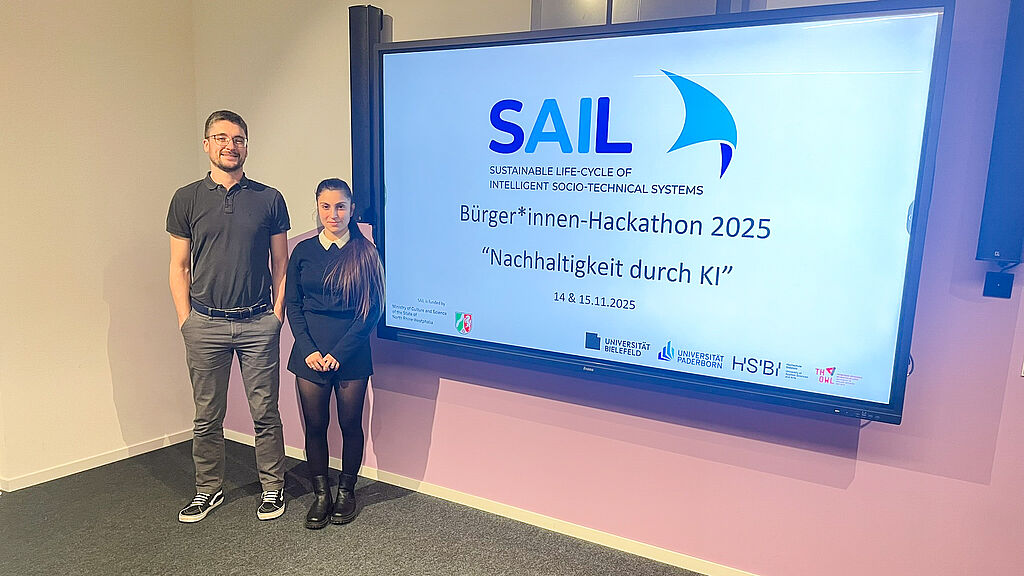
How can artificial intelligence help make our everyday lives more sustainable – and what does sustainability actually mean in this context? These questions were addressed at an open hackathon for citizens organised by the ‘SAIL – Sustainable Life-Cycle of Intelligent Socio-Technical Systems’ project on 14 and 15 November as part of the ‘GENIALE’ science festival at the Wissenswerkstadt Bielefeld.
The workshop was organised and led by Peter Kuchling from Bielefeld University of Applied Sciences and Sinem Görmez, research assistant in the inIT research group ‘Human-Technology Interaction’ headed by Prof. Dr. mult. Carsten Röcker. The two were on hand throughout the weekend to provide participants with suggestions, tips and technical know-how. This made it possible even for people with no programming experience to develop their own ideas and contribute them to the exchange.
From sustainability to AI and step by step towards your own idea
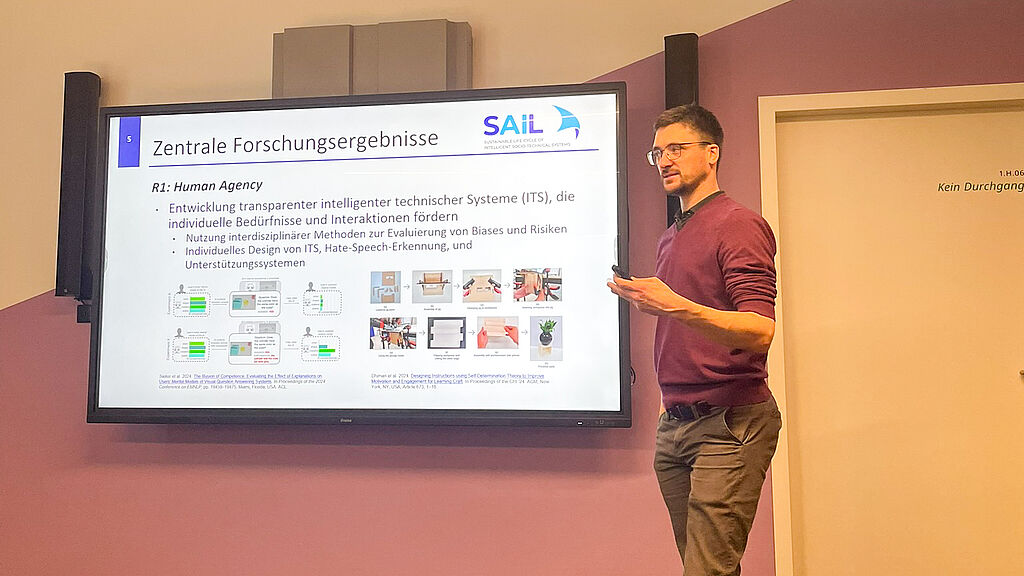
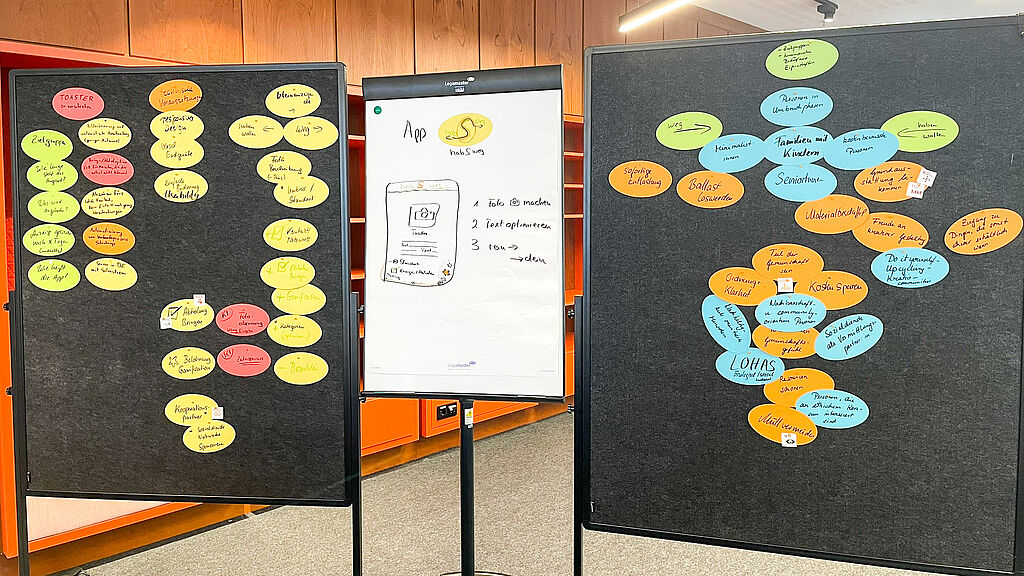
The hackathon was aimed at interested individuals aged 14 and above and was deliberately designed to be accessible. Peter Kuchling began with a brief introduction to the topics of sustainability, AI and the Sustainable Development Goals (SDGs), the global goals for sustainable development. The focus then shifted to open discussion: participants worked together to gather ideas about what sustainability means in everyday life and how AI can contribute to it.
Building on this, the participants developed initial ideas in small working groups, ranging from app sketches and text drafts to considerations of AI-supported functions such as gamification elements, community-oriented approaches or technical support through photo recognition. The ideas were then assigned to the SDGs to illustrate which global sustainability goals they address. This showed that even simple methods and low-threshold tools are sufficient to develop new perspectives and initial ideas.
Citizen science: a valuable exchange for both sides
The hackathon tied in with SAIL's aim of making research visible and accessible to society and actively involving people outside the scientific community. The goal is to gain new perspectives, open up research, strengthen social relevance and enable new insights to be gained together. The open exchange during the event showed how helpful different perspectives can be in developing initial ideas for the responsible use of AI.
Sinem Görmez emphasises the value of this dialogue:
‘The different perspectives were really valuable – the discussions showed that simple methods and open exchange can lead to surprisingly good ideas.’
About SAIL
The SAIL project is an interdisciplinary and interinstitutional collaboration between Bielefeld University, Paderborn University, Bielefeld University of Applied Sciences and Arts and the Technische Hochschule Ostwestfalen-Lippe, funded by the Ministry of Culture and Science of North Rhine-Westphalia.
Find out more about the SAIL project: www.sail.nrw